


Tick Surveillance
Working together for a healthier tomorrow!
Craig P. Umbel, LEHS
Director of Environmental Health
Room 102
Phone: 301-334-7760
FAX: 301-334-7769
E-Mail: environmental.health
@maryland.gov
Hours of Operation:
Mon. – Fri. 8:00am – 5:00pm
Tick Species Found in Garrett County
Currently, 4 species of ticks of various life stages have been found throughout Garrett County since surveillance efforts began. By far, the largest tick population is that of the blacklegged tick, also known as the deer tick. These ticks have the potential to transmit a number of agents causing diseases such as Lyme and Anaplasmosis. Another common tick is the American Dog tick, which is found pretty frequently throughout the county. Some less common, but still present species include the Asian Longhorned tick and the Lone Star tick.
Tick Life Cycle:
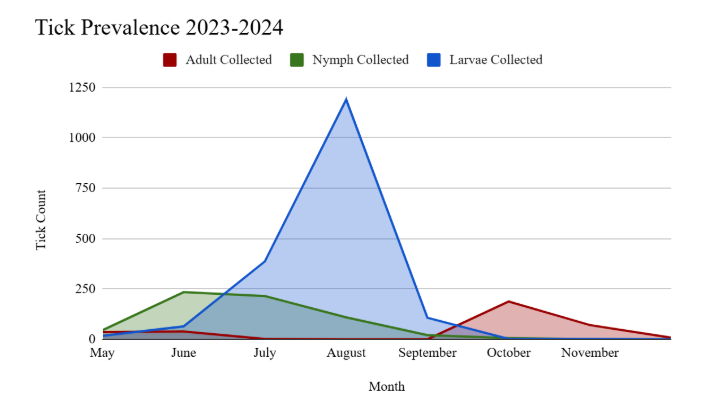
Ticks found in Garrett County undergo 4 main life stages over a 2-3 year period: Egg, Larval, Nymphal, and Adult. Ticks of all life stages can be active all year, as long as temperatures are above freezing. You should typically expect to see mostly adults in fall through spring, and nymphs and larva are more common during late spring and throughout the summer.
—
Larval:
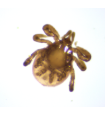
After hatching from eggs, a tick becomes what is known as larva, commonly called seed ticks. These microscopic creatures tend to be active most frequently in the mid-to-late summer, where they seek a host, typically a small animal or rodent such as mice, chipmunks, small birds, etc. Attachment to a white-footed mouse is the primary way that ticks acquire many of the pathogens that can infect people if they are later bitten.
Larva are considered less harmful to people and pets because they frequently don’t possess any of the pathogens that can make them sick. They may bite people, but it is less commonly seen compared to later life stages.
After a tick larva has its first blood meal, it can molt into a nymph.
Nymphal:
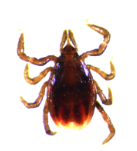
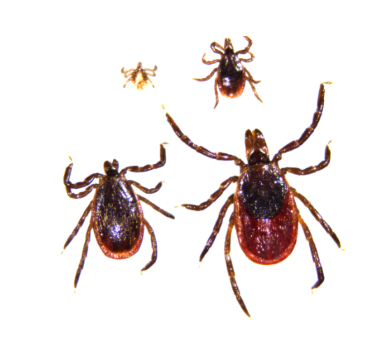
Nymphal ticks are juvenile ticks that tend to be most active during the late spring into the summer. They are very small, flat, and tend to be dark in color. Nymphs tend to be the size of a poppyseed or a pen tip.
Nymphs will feed on any small or large animal that they can find, typically rodents, deer, pets, or sometimes humans. They, like all 3-host ticks, exhibit a behavior named “questing” when trying to find a host. A tick will sit on the end of vegetation, such as grass, and hold its front legs out in the air, attaching itself to any animal that brushes by. After grabbing on to a host, a nymph may attach quickly or may wander around until it finds a suitable place to bite.
Nymphs are less likely to be carriers of pathogens harmful to humans, but their bites often go undetected due to their small size. This makes them more hazardous to humans.
A nymph may feed for several days until it is full, or engorged. It will then detach itself and molt into an adult.
Adult:
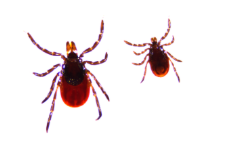
Adult ticks are the largest form of a tick and tend to be the most pathogenic. They are large (about the size of a popcorn kernel) and black or reddish-brown in color. Typically, adult tick activity peaks in the spring and fall, but can be active year round, as long as the weather is above freezing.
Adult ticks can be female or male. Female adult ticks are larger and more likely to attach to humans. Their primary goal is laying eggs, and will seek a third blood meal in order to prepare to do so. Adult male ticks do not feed as commonly as females do, but may attach to a host to wait for a female to breed with.
Ixodes scapularis (Blacklegged or Deer Tick)
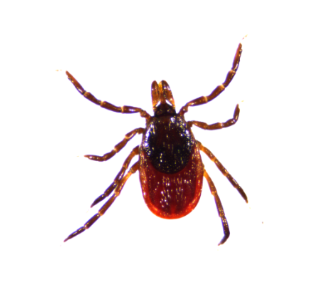
- scapularis, commonly known as the blacklegged or deer tick, is the most common tick found in Garrett County. They are extremely common throughout the Eastern and Midwestern United States. They thrive in habitats where white-tailed deer are common, especially in forested areas.
Deer ticks tend to dry out easily, so they thrive in damp, forested environments with lots of vegetation.
Deer ticks are importantly known for their ability to transmit borrelia burgdorferi, the bacteria that causes Lyme disease in humans and some animals. They are also able to transmit a number of other pathogens, including those that cause Anaplasmosis and Babesiosis.
I.scapularis, like many ticks, have a 2 year life cycle with 3 notable life stages: larval, nymphal, and adult. Nymphs typically appear as tiny black specks, about the size of a poppyseed. Adults are larger, and can be reddish-brown to black in color. Engorged ticks (those full of blood) will appear greyish.
Dermacentor variabilis (American Dog Tick)
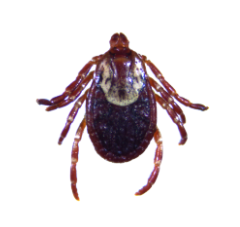
- variabilis, commonly known as the American Dog Tick, is commonly found in Garrett County. They tend to be larger than deer ticks as adults, and can be gray-brown or reddish brown in color. Dog ticks can be found in forested or grassy areas- they tolerate taller grasses more so than blacklegged ticks, which tend to inhabit forests and treelines. They are less susceptible to drying out than other ticks species.
Dog ticks are able to transmit bacteria causing Rocky Mountain Spotted Fever (RMSF) and Tularemia to humans and dogs. Cats are susceptible to Tularemia, but are rarely affected by RMSF. Dog ticks are not considered to be a vector for the bacteria causing Lyme Disease.
Similarly to blacklegged ticks, dog ticks tend to live for about 2 years, going through a larval, nymphal, and adult stage. However, their life cycle is slightly different in that they tend to be relatively inactive in late fall and early winter in comparison to blacklegged ticks, which are more consistently active year-round.
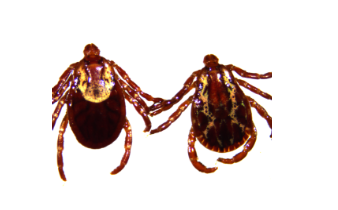
https://extension.umaine.edu/ticks/maine-ticks/american-dog-tick/
Haemaphysalis longicornis (Asian Longhorned Tick)
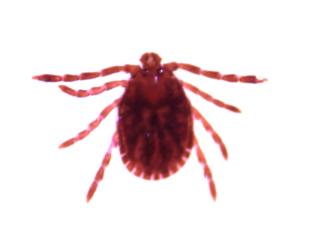
The Asian Longhorned Tick is an invasive species that is relatively new to the region. It was first found in the United States in New Jersey in 2017, and since then has spread throughout the Eastern US, including into Maryland and Garrett County. Based on routine tick surveillance, the Asian Longhorned tick is rarely found in the county, but this could change in upcoming years depending on a number of factors.
This species is not able to transmit many of the pathogens commonly associated with tick bites. Currently, Asian Longhorned ticks have not been known to cause any illness in humans in the US, though they have transmitted pathogens to humans in other parts of the world. In their native environment, this tick has been shown to be capable of transmitting pathogens that cause anaplasmosis, babesiosis, and Powassan virus. In addition, these ticks can transmit bovine theileriosis, an infection that can be harmful to cattle in the area.
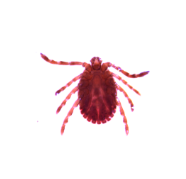
Asian Longhorned ticks tend to be plain in appearance, with adults being brown or reddish brown in color with no distinct patterning on their backs. They tend to be similar in size to other ticks, with adults growing to be around 0.1 inches, the size of a small seed. Like all ticks, they are flat and slow moving.
Interestingly, the Asian Longhorned tick is capable of parthenogenesis, or asexual reproduction. An adult female is capable of laying eggs and reproducing without a male. This makes males very rare, and reportedly hadn’t been discovered in the US until 2023.
Asian Longhorned ticks can be active year round, but are most commonly seen during the summer months. Adults tend to be most active from June through August, while nymphs are typically found in May and June.
This tick is commonly found on livestock in the US, but can attach to a number of other animals, including humans and pets. They pose a significant threat to livestock as many can attach to one animal at a time, which puts livestock at risk of severe anemia and other complications.
https://pubmed.ncbi.nlm.nih.gov/40152478/
https://pmc.ncbi.nlm.nih.gov/articles/PMC10645392/
https://extension.psu.edu/asian-longhorned-tick-haemaphysalis-longicornis
Amblyomma americanum (Lone Star Tick)
https://www.cdc.gov/ticks/about/where-ticks-live.html
The Lone Star tick is not common to Garrett County or Maryland, but has been found a few times since surveillance efforts began.
The Lone Star tick poses a unique threat to people, as they are known for transmitting several pathogens not transmitted by other ticks in the area. This includes the pathogens that cause STARI and Alpha-gal syndrome, which can cause an allergy to red meat. It is also considered a strong possibility that Lone Star ticks can transmit bacteria causing other illnesses such as Rocky Mountain Spotter Fever and Tularemia. Since the Lone Star Tick is rarely found in Garrett County, the risk that these ticks pose to humans and pets is not fully understood. Lone Star ticks are not considered a vector for Lyme Disease.
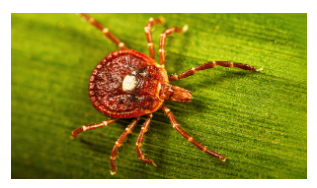
The Lone Star tick varies in appearance depending on its age and gender. Nymphs appear similar to nymphs of other tick species, small, dark or brown in color, and flat. Male adults are brown in color with a dark ornate pattern found on their back. Female Lone Star ticks are the most distinctive, typically presenting as brown in color with a white dot on the middle of its back.
This species tends to be notable in that they actively seek a host, unlike most other tick species. Most ticks passively await a host to come by, but Lone Star Ticks can sense a host from nearby and travel to pursue them. Like many tick species, these ticks prefer wooded, brushy areas that allow them to stay moist while seeking a host.
Lone Star ticks tend to have a 2 year, 3 host life cycle, much like other ticks in the area.
https://pmc.ncbi.nlm.nih.gov/articles/PMC8352541/
By Melinda A. Smith-Pritt, LEHS, and Veronica Crenshaw





¿Prefieres español?
Language Assistance
LanguageLine services are available.
Spanish (Medical Spanish) interpreter available in-person, upon request.