


Tick Surveillance
Working together for a healthier tomorrow!
Craig P. Umbel, LEHS
Director of Environmental Health
Room 102
Phone: 301-334-7760
FAX: 301-334-7769
E-Mail: environmental.health
@maryland.gov
Hours of Operation:
Mon. – Fri. 8:00am – 5:00pm
Risks Associated With Ticks
Ticks of different species can pose a number of risks to people and pets. Ticks can transmit a number of different agents to a host while feeding. Ticks feed on a host for several days, and during that period, small amounts of tick saliva can enter the host. If the tick is carrying a pathogen from a previous host, that pathogen can then enter the new host and progress to an infection.
Through a grant with the Centers for Disease Control and Prevention, blacklegged ticks collected from active surveillance efforts are tested for several pathogens including those responsible for Lyme Disease, Anaplasmosis, Babesiosis, and Ehrlichiosis.
The most common risk that ticks pose to humans is known as Lyme Disease. It is transmitted by the deer tick in Garrett County. Other tick-borne illnesses found in the area include anaplasmosis and babesiosis. It is not uncommon to be unaware that a tick has bitten you and made you sick. Ticks produce a substance in their saliva that numbs the area they bite. If you are experiencing flu-like symptoms and have recently spent time outdoors or know you’ve had a tick bite, consider seeing a doctor to prevent any infection that may be present.
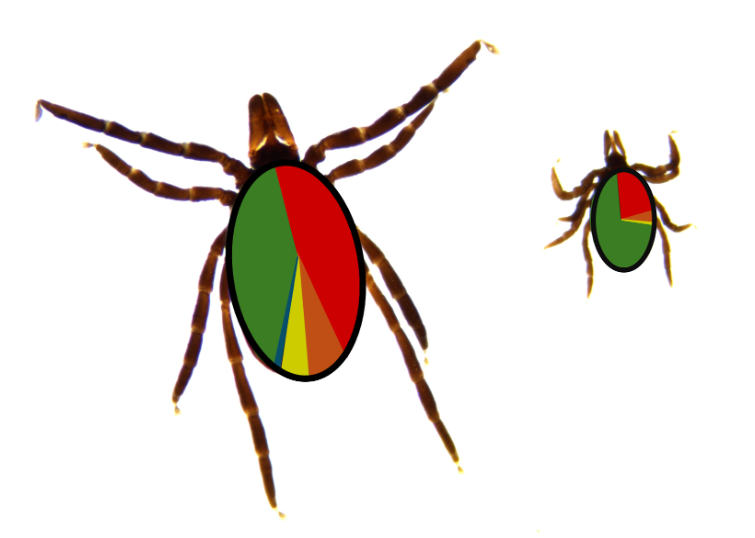
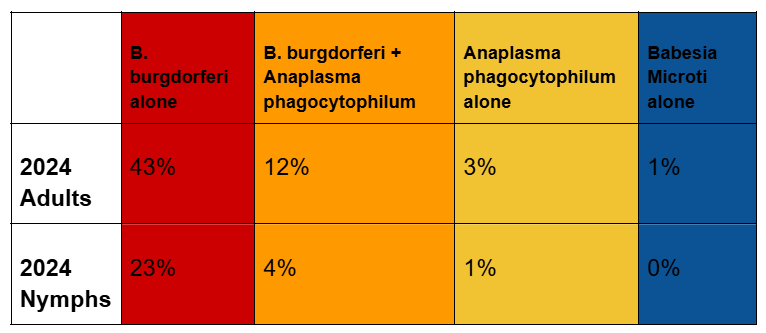
Approximately 41% of adults and 72% of nymphal black legged ticks that were tested in 2024 were not infected with a pathogen (shown in green).
Lyme Disease
Lyme Disease is a bacterial infection caused by the bacteria Borrelia burgdorferi. It is the most common tick-borne illness in Garrett County and throughout the Northeastern United States.
Lyme Disease in Garrett County is primarily contracted from the bite of a blacklegged tick. Blacklegged ticks contract B. burgdorferi from white-footed mice, which are carriers of the bacteria. When a tick feeds on a carrier mouse, it picks up the bacteria and can then transmit it to other animals, including dogs and humans. In recent years, anywhere from 25-35% of nymphal (juvenile) blacklegged ticks have been shown to be infected with the bacteria causing Lyme. Adult ticks are more commonly carriers of Lyme, with over 60% of ticks found testing positive for the bacteria, but are easier to find on a host, making transmission less likely. Transmission of Lyme to a human typically occurs after 24 hours of attachment to a person.
Symptoms of Lyme Disease typically present within a few days to a few weeks of infection. Common symptoms include a circular “bullseye” rash, fever and flu-like symptoms, stiffness or swelling in joints near the bite. A Lyme Disease rash does not always appear circular or exhibit a “bullseye” pattern, and may be harder to see on darker skin tones. https://www.cdc.gov/lyme/media/pdfs/Wall-poster-The-Many-Forms-of-Lyme-Disease-Rashes-Erythema-Migrans.pdf
Later stages of Lyme can bring about complications with the heart, nervous system, and lymphatic system, but are rare and almost always treatable.
A rash or redness around the site of a tick bite is not always indicative of Lyme Disease infection, but should be monitored carefully, especially when accompanied by other symptoms. If you suspect Lyme disease or are experiencing symptoms following a tick bite, contact your healthcare provider for assistance.
Lyme Disease can be treated with antibiotics, but it is important to receive treatment as early as possible to limit severity of symptoms. Symptoms typically resolve within a few weeks of treatment, but may persist following treatment for weeks to years.
*Special note: Lyme Disease very rarely infects cats, as their immune systems are generally able to prevent infection without clinical interventions.
https://pmc.ncbi.nlm.nih.gov/articles/PMC2440571/
https://www.ncbi.nlm.nih.gov/books/NBK532894/
https://www.cdc.gov/lyme/causes/index.html
https://www.globallymealliance.org/about-lyme/diagnosis/stages/
Anaplasmosis
Anaplasmosis is a bacterial infection caused by the bacteria Anaplasma phagocytophilum. It is the second most common tick-borne illness seen in Garrett County, seen primarily in blacklegged ticks.
Ticks contract the bacteria causing anaplasmosis from wild mammals, including white-footed mice and white-tailed deer. Ticks can contract this bacteria and then transmit it to humans and pets, including dogs and cats. Based on surveillance data in recent years, anywhere from 8-13% of adult ticks in Garrett County may be carriers of the bacteria causing anaplasmosis in humans. In nymphal (juvenile) ticks, this number is around 5-6% of the tick population.
Anaplasmosis is similar in presentation to Lyme Disease, and treatment tends to be the same as well. Common signs and symptoms include fever, general fatigue, tenderness in muscles and joints, and a headache following a tick bite. Transmission of the bacteria causing anaplasmosis typically occurs within 12-24 hours of a tick being attached. In contrast to Lyme disease, it is rare to see a rash with anaplasmosis infections. Typically, only redness at the site of the bite occurs from skin irritation.
Anaplasmosis can be treated with antibiotics, similarly to Lyme disease. Both are typically treated with doxycycline, though other antibiotics may be used depending on the patient and the prescribing physician. Symptoms generally resolve within days to weeks after beginning treatment.
Severe and fatal anaplasmosis is more likely to occur in vulnerable populations, such as immunocompromised individuals and older adults. Severe, untreated anaplasmosis can lead to complications impacting the respiratory, muscular, and nervous systems. Anaplasmosis has been fatal in >1% of cases, and is more likely to occur in vulnerable populations.
It is also important to note that many ticks that are carriers of anaplasmosis in the area may also be carriers of other bacterial/viral pathogens, with Lyme Disease being the most common. Of the ticks that tested positive for Lyme Disease in 2023-2024 in Garrett County, around 18% also tested positive for the bacteria causing Anaplasmosis.
https://www.ncbi.nlm.nih.gov/books/NBK513341/
https://pmc.ncbi.nlm.nih.gov/articles/PMC3717505/
Babesiosis
Babesiosis is a rare infection caused by the protozoa Babesia microti, which infect and reproduce in red blood cells. The primary vector of babesia in Garrett County is the blacklegged tick. This tick typically contracts the parasite that causes babesiosis from small rodents, such as the white-footed mouse.
People with babesiosis are frequently asymptomatic (around 20% of adults and 50% of children). Asymptomatic infections tend to be less severe. For those who present with symptoms, flu-like symptoms tend to be present: fever, fatigue, loss of appetite, muscle or joint aches. Vulnerable populations (those who are likely to experience more severe symptoms) include immunocompromised, older adults, and people who don’t possess a spleen. These individuals are more likely to experience severe symptoms and complications.
Any tick that is a carrier of babesia typically takes at least 36-72 hours to transmit the pathogen to a human host. Currently, there have been no reported human cases of babesiosis in Garrett County, though there have been reported cases in other parts of Maryland and surrounding states. In 2024, tick surveillance efforts revealed the presence of babesia microti in about 1% of ticks collected. Though this is a small percentage of the tick population, it is the first time in recent years that babesia positive ticks have been detected.
Babesiosis often requires a more rigorous treatment than antibiotics alone, especially if not caught early. Those that present asymptomatically generally don’t require treatment, but infection may persist in symptomatic people without treatment. If you have been bitten by a tick and begin to exhibit symptoms within 1-4 weeks of the initial bite, contact a healthcare professional.
https://www.columbia-lyme.org/babesiosis
Rocky Mountain Spotted Fever
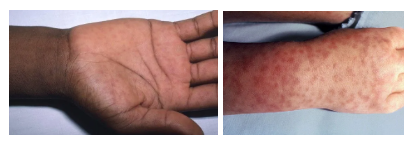
Rocky Mountain Spotted Fever (RMSF) is an infection caused by the bacteria Rickettsia rickettsii. It is most commonly seen in the South-Eastern and South Central United States, but can occur in Garrett County/Maryland.
R. rickettsii is typically transmitted to humans through the bite of an infected American Dog tick, which picks up the pathogen from small rodents in the area. Transmission to a human can occur within 4-6 hours or sooner, in some cases. After transmission, symptoms can begin occurring within 5-10 days.
Common symptoms include a sudden onset fever, headache, muscle and joint aches, and other flu-like symptoms. Within a few days of fever onset, a spotted rash may appear on the hands and feet and spread throughout the body.
Rocky Mountain Spotted Fever is rare, but can be life threatening if left untreated. Treatment typically entails antibiotics and rest. RMSF is particularly life threatening in young and old populations, immunocompromised populations, and those with G6PD deficiency.
https://www.columbia-lyme.org/rocky-mountain-spotted-fever
https://www.cdc.gov/rocky-mountain-spotted-fever/about/index.html
https://www.ncbi.nlm.nih.gov/books/NBK430881/
Rash:
https://www.jucm.com/a-10-year-old-with-fever-headache-muscle-aches-nausea-and-a-suspicious-rash/2/
https://www.mountsinai.org/health-library/diseases-conditions/rocky-mountain-spotted-fever
By Melinda A. Smith-Pritt, LEHS, and Veronica Crenshaw




¿Prefieres español?
Language Assistance
LanguageLine services are available.
Spanish (Medical Spanish) interpreter available in-person, upon request.