


Tick Surveillance
Working together for a healthier tomorrow!
Craig P. Umbel, LEHS
Director of Environmental Health
Room 102
Phone: 301-334-7760
FAX: 301-334-7769
E-Mail: environmental.health
@maryland.gov
Hours of Operation:
Mon. – Fri. 8:00am – 5:00pm
Preventing Tick Bites
The best way to reduce your risk of getting a tick borne disease is simply to avoid getting bitten by a tick. There are many factors to consider, as tick exposure is pretty common, even if you don’t spend much time outdoors. There are a number of ways to reduce tick exposure, including by prevention of contact with yourself, your pets, and your yard. Knowing where ticks live and how you can come across them can help you avoid them. Repellents and proper gear can also play an important role in tick bite prevention.
Resources & References:
For Yourself
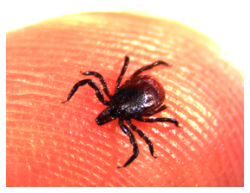
Prevention of tick bites is widely considered the best way to avoid potential tick-borne illnesses. There are a number of ways to prevent the likelihood of a tick biting you.
- Take care in choosing an outfit
- Light colored, long sleeved clothing is preferred- it is easier to see a tick than on darker clothing
- Tucking pants into socks can prevent ticks from crawling up your legs
- Wearing clothing treated with insect repellants such as permethrin can keep ticks from biting
- If possible, avoid extended periods of time in tick friendly habitats
- Do daily tick checks if you live in a tick-friendly environment or spend a lot of time outside
- After coming inside, thoroughly check your body for ticks. Ticks can attach anywhere, but prevent warmer areas such as between toes, in the belly button, behind ears, etc. Most tick-borne illnesses take about 24 hours to fully transmit, so checking once a day can help you avoid getting sick.
- Take a shower within 2 hours after coming indoors
- Taking a shower soon after coming indoors can wash away any unattached ticks on your body. It will not remove any ticks that have already attached.
- Stay in the center of hiking trails
- Avoid going off trail as ticks can be found in vegetation and brush nearby
Insect Repellents:
There are a number of repellents and sprays that can be used to prevent tick bites.
Permethrin
There are a number of products that contain 0.5% permethrin, an agent that is considered an insecticide for a number of insects and arthropods such as ticks. Permethrin works by overexciting the nervous system of ticks and insects, eventually causing their death.
Permethrin is only to be used on outer layers of clothing and hiking gear. It is not recommended for use on skin. Treatment can be effective on clothing through 3-4 washes. Some manufacturers sell clothing pre-treated with permethrin at the time of purchase. These products are effective for much longer than clothing treated at home, potentially withstanding about 70 washes.
It is also known to be harmful to cats, so use of permethrin should be carefully monitored in homes containing cats. It is not considered harmful to humans and dogs, but should still be used carefully. Make sure to carefully follow instructions on any products containing permethrin.
DEET
DEET is a common insect repellent that can be used on skin. There are a number of commercial products containing DEET available. It is most effective in concentrations of over 20%, but has not been shown to be more effective after a concentration of 50%. Concentrations of 20% or more can prove to be effective for 5-6 hours, after which reapplication should be used.
DEET can be applied directly to the skin, but should be applied outdoors for adequate ventilation. It should only be applied to exposed skin, not underneath clothing.
Picaridin
Picaridin is an alternative to DEET that can be applied to the skin. Some people prefer it to DEET because it tends to be less irritating to the skin. Research has shown that picaridin has similar effectiveness to DEET at similar concentrations, indicating that both are able to provide several hours of protection.
Essential Oils
The effectiveness of essential oils to repel tick bites has not been well studied. Plant-derived repellent products are not regulated by the EPA and therefore their efficacy is not required to be documented. For this reason, it is difficult to decisively say which essential oils are effective and how long they are effective for. Some studies have indicated that essential oils such as cinnamon, clove, cypress, etc. are effective for 30 minutes to an hour at deterring a tick from biting. Compared to DEET and other EPA regulated repellents, which can last to around 6 hours in higher concentrations, this is not considered the most effective option.
It is also important to be cautious when applying essential oils to the skin, as high concentrations of any essential oil can irritate the skin. If you are using essential oil as an insect repellent, it is strongly recommended that the oil is diluted in some way, such as in a lotion, petroleum jelly, or ethanol at a 1:9 ratio of oil to product.
There are also a number of other EPA approved insect repellents, most of which are effective against ticks. For more information, visit: https://www.epa.gov/insect-repellents/skin-applied-repellent-ingredients
https://www.nature.com/articles/s41598-023-28820-9
https://www.consumerreports.org/insect-repellent/how-deet-and-permethrin-can-protect-you/
https://npic.orst.edu/factsheets/DEETgen.html
https://www.epa.gov/insect-repellents/deet
https://ccmedia.fdacs.gov/content/download/3188/file/permethrin%20qa%203-20-13.pdf
https://pmc.ncbi.nlm.nih.gov/articles/PMC8617816/#sec8-pathogens-10-01379
For Your Home
There are a number of ways to prevent ticks from infesting your yard. Preventing infestation can help you and your pets from picking up ticks in your yard.
- Mow the lawn regularly
- Keeping your grass to 3 inches or less can make it harder for ticks to survive in your yard. Ticks prefer humid environments, and so keeping your grass short can help it stay dry and tick-free
- Remove any brush, leaf litter, etc. from your lawn
- A common place to find ticks is in damp, shady areas such as in leaves
- Add a 3 foot barrier of mulch or gravel to the perimeter of your yard. Ticks will not usually cross dry areas
- Discourage rodent activity
- Seal any holes in walls or the foundation of your house, set traps, etc. Keeping birdfeeders away from common areas can decrease mouse activity
- Avoid using plants that attract deer
- Ticks can come into your yard after living/feeding on a deer, so keeping them out of your yard can keep tick activity low
- Trim trees branches and shrubs to allow more light to reach your yard
- This can keep things drier and discourage tick activity
- Keep playsets, sandboxes, etc at least 3 feet from forest edges to keep ticks from finding children while playing
For Pets
A common way for you to get ticks is through your pets. They can pick them up while outside and the ticks can crawl onto you later on. A number of tick-borne diseases can also affect your pets and make them sick. To keep you and your pet tick-free, consider the following:
- Use preventative medications. There are a number of topical and oral medications that can be used to deter ticks and fleas. Talk to your veterinarian about what medications will work best for you and your pet.
- Note: some medications that are safe for dogs are not safe for cats, and vice versa. Follow instructions to avoid negative interactions
- Preventative medications are most effective when used year round. Tick activity can occur as long as the temperature is above freezing, so using preventative measures for the entire year is considered the most effective way to prevent tick bites
- Check your pet
- Doing daily tick checks can keep ticks from biting you or your pet. Common areas that ticks are found on pets include: around and behind the ears, armpits, groin, and tail.
Ticks can also infest and feed on livestock, such as cattle and horses. These animals can be susceptible to a number of tick-borne diseases, and widespread infestations can cause further complications. To prevent tick infestations and illness, consider the following:
- Move fencing to be 10 feet away from any forest line, and keep vegetation mowed/well kept, trim tree branches to reduce humid conditions
- If possible, perform regular tick checks on an animal. Ticks can bite anywhere on the body, but tend to prefer warmer areas with thinner skin, such as on the chest, under the jaw, near the ears and eyes, etc.
Tick Infestation
A tick infestation can occur when a large number of ticks feed on one animal at a time. This can lead to a number of detrimental effects, such as blood loss, anemia, skin damage, weight loss, and in severe cases, death. This can potentially reduce productivity of livestock and lead to economic losses. Tick prevention methods, listed above, can greatly reduce the potential for this occurring.
https://www.aphis.usda.gov/sites/default/files/bovine-anaplasmosis-infosheet.pdf
https://www.cfsph.iastate.edu/Infection_Control/Routes/English/general_tick_control.pdf
By Melinda A. Smith-Pritt, LEHS, and Veronica Crenshaw



¿Prefieres español?
Language Assistance
LanguageLine services are available.
Spanish (Medical Spanish) interpreter available in-person, upon request.