



Health Care Provider Memo
Date: June 24, 2025
From: Melinda Smith-Pritt, Veronica Crenshaw
Questions: [email protected], [email protected]
RE: Ixodes Scapularis Surveillance and Lyme Disease Risks in Garrett County
The following information has been provided by the Garrett County Health Department’s Office of Environmental Health and represents phenology and pathogen prevalence for Ixodes scapularis, the Blacklegged Tick, also known as the deer tick. In recent years personnel have conducted routine tick surveillance throughout Garrett County, mostly on lands with public access camping and/or hiking trails. Ticks are sent to the Centers for Disease Control and Prevention for DNA pathogen testing. During surveillance events, Dermacentor variabilis (American Dog Tick) and Haemaphysalis longicornis (Longhorn Tick) have also been collected but are not represented in the datasets below. More information on those ticks will be provided in future correspondence.
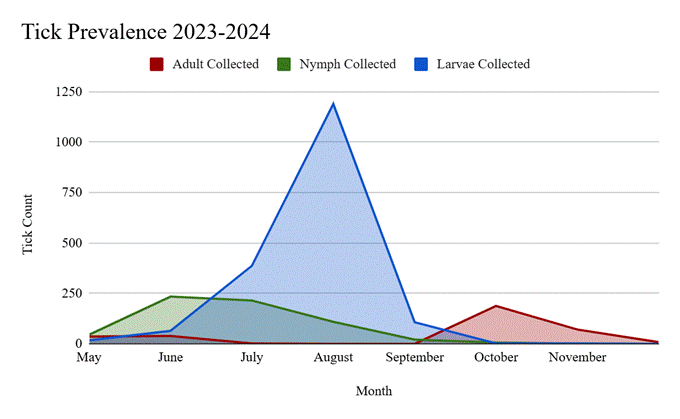
Ticks can be active throughout the year, any time that temperatures are above 40℉. Ticks in Garrett County generally have a 2 year life cycle, beginning in the spring the first year and ending around 2 years later in the spring or early summer. Nymphs, or juvenile ticks, are most active during late spring and summer months, as they seek a host for a blood meal. It is less common to see nymphal ticks infected with pathogens, but they pose a larger risk due to their small size often going undetected on a host. Adult ticks become most active in the fall and spring. Adult ticks are easier to detect on the body, but are much more likely to contain various pathogens that can infect humans, such as B. burgdorferi, the bacteria that causes Lyme Disease, and Anaplasma phagocytophilum, the bacteria causing Anaplasmosis.
| Total Ticks Tested | B. burgdorferi alone (%) | B. burgdorferi + Anaplasma phagocytophilum (%) | Anaplasma phagocytophilum alone (%) | Babesia Microti alone (%) | |
| 2024 Adults | 275 | 116 (42.18) | 32 (11.64) | 7 (2.55) | 3 (1.09) |
| 2023 Adults | 69 | 37 (53.62) | 9 (13.04) | 0 (0) | 0 (0) |
| 2024 Nymphs | 489 | 108 (22.09) | 19 (3.89) | 6 (1.23) | 0 (0) |
| 2023 Nymphs | 145 | 42 (28.97) | 9 (6.21) | 0 (0) | 0 (0) |
On average in 2023 and 2024, 18.55% of ticks that tested positive for B. burgdorferi also tested positive for another pathogen, namely Anaplasma phagocytophilum. With this in mind, it is vital to consider the possibility of co-infection when evaluating patients with tick-borne diseases. especially with Babesia becoming more common in the area. Neglecting to consider co-infection can potentially prolong and worsen symptoms in a patient. 2024 was the first year that Babesia microti was detected in the Black Legged tick. All positives came from adults that were collected in the South Eastern region of the County.
Shareable PDF Copy of Memo: https://garretthealth.org/wp-content/uploads/2025/06/Garrett-County-Health-Care-Provider-Memo_-Ixodes-Scapularis-Surveillance-and-Lyme-Disease-Risks-in-Garrett-County.docx.pdf

Contact: [email protected]
- What Is Problem Gambling? - March 6, 2026
- Upcoming Event Scheduled! – Kitzmiller Pickleball Clinic - March 6, 2026
- How to Extend the Life of Your Septic System - March 6, 2026